Here's your blog post:
The Astonishing Power of Compound Interest: How Your Money Makes Money (and More Money!)
Hey there, savvy investor (or soon-to-be savvy investor)! Ever feel like your money is just… sitting there? Like a couch potato watching other, more athletic dollars sprint towards financial freedom? We all do! But what if I told you there was a secret weapon, a financial superpower, that could turn your lazy dollars into a team of tireless workers, constantly earning more and more? It’s not magic, folks, it’s compound interest, and it’s about to become your new best friend.
Think of it like this: you plant a seed, right? That seed grows into a tree. The tree then produces fruit. Compound interest is like letting that fruit fall, sprout, and grow into evenmoretrees. It’s money making money, and then that moneyalsomaking money. It’s the financial equivalent of an unstoppable multiplying bunny rabbit army (minus the, uh, ecological concerns). It's an evergreen process!
I know, I know, “compound interest” sounds like something your grandpa mumbled while reading the newspaper. But trust me, understanding it is the key to unlocking some serious wealth-building potential. Are you ready to take control of your financial future? To harness the awesome power of compounding and watch your investments blossom? Then stick around, because we're about to dive deep into the wonderful world of compound interest and how it can transform your financial life. You may be surprised how much you don't know about something you thought you already understood!
Unlocking the Secrets of Compound Interest: Your Guide to Exponential Growth
Alright, friends, let's get down to brass tacks. We're going to unpack compound interest, show you why it's so powerful, and give you the tools you need to make it work for you. Forget complicated jargon and confusing formulas; we're keeping it real and relatable. Let's get started!
What Exactly Is Compound Interest?
At its core, compound interest is interest earned on interest. Simple interest, on the other hand, is only earned on the principal, the initial amount of money. With compound interest, you earn interest not only on the principal, but also on the accumulated interest from previous periods. This creates a snowball effect, where your earnings grow exponentially over time. The more frequently your interest compounds (daily, monthly, quarterly, annually), the faster your investment grows.
Imagine you deposit $1,000 into an account that earns 5% interest per year, compounded annually. After the first year, you'll have $1,050. In the second year, you won't just earn 5% on the original $1,000; you'll earn 5% on $1,050. That's $52.50 in interest, bringing your total to $1,102.50. See how the interest earned in the second year is higher than the first? That's the magic of compounding!
The Power of Time: Your Greatest Ally
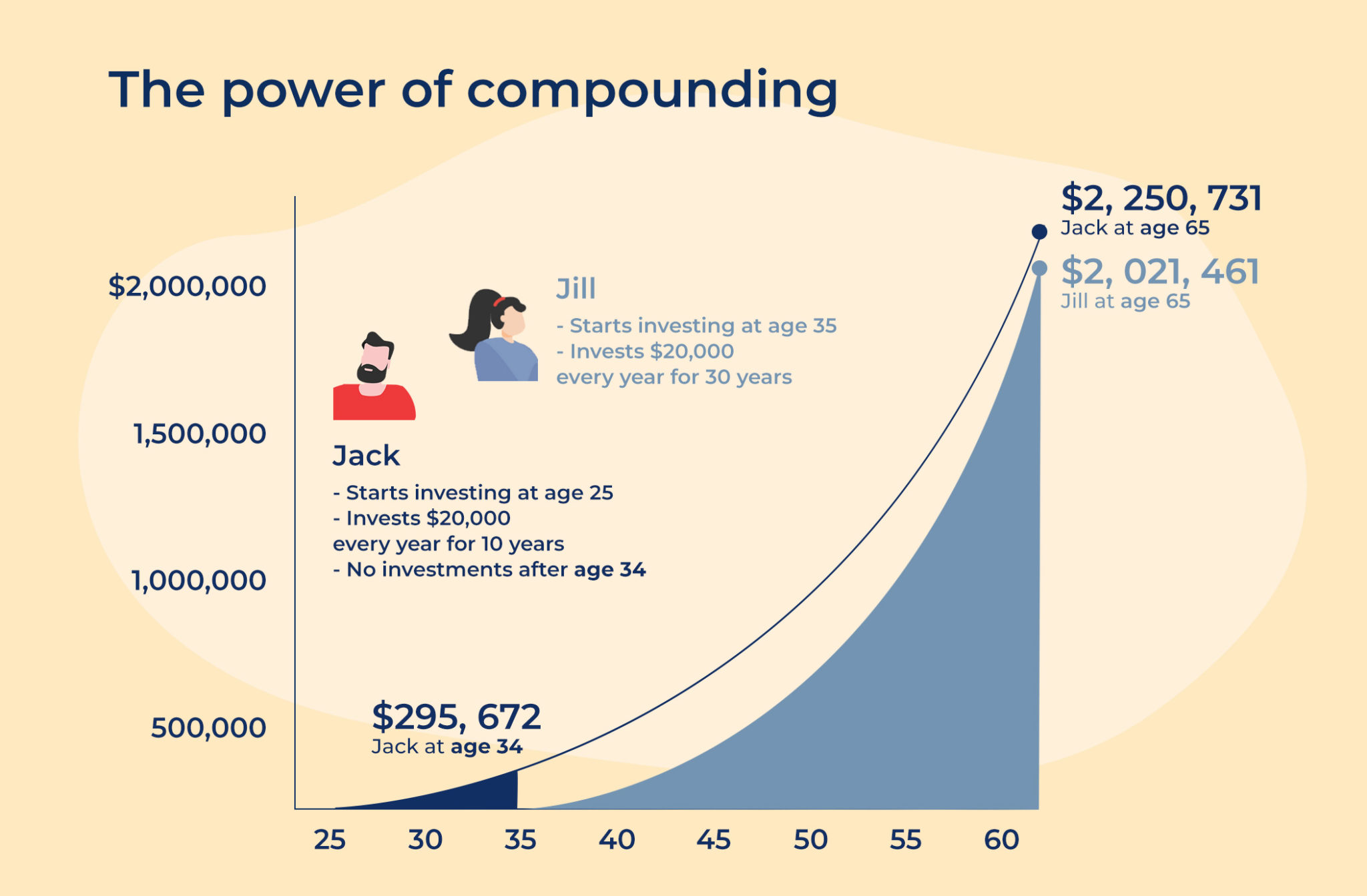
Here's a truth bomb: time is your most powerful weapon when it comes to compound interest. The longer your money has to grow, the more significant the impact of compounding becomes. This is why starting early is so crucial. Even small amounts invested consistently over long periods can yield impressive results.
Consider two friends, Sarah and Tom. Sarah starts investing $200 per month at age 25, earning an average annual return of 7%. Tom, on the other hand, doesn't start investing until age 35, but he invests $400 per month, also earning 7%. By age 65, Sarah will have accumulated significantly more money than Tom, even though Tom invested twice as much each month. This is because Sarah had a 10-year head start, allowing her investments to compound for a longer period.
Factors Influencing Compound Interest Growth
Several factors influence how quickly your investments grow with compound interest. Understanding these factors can help you make informed decisions and maximize your returns. Here are the key elements:
• Principal Amount: The initial amount you invest directly impacts the growth. The larger the principal, the greater the interest earned in each period. If you start investing with $10,000, the compounding will be much more noticeable than if you start with $100.
• Interest Rate: The interest rate is a crucial determinant of growth. Higher interest rates lead to faster compounding. Small differences in interest rates can result in significant variations in returns over time. For example, an investment earning 8% annually will grow substantially faster than one earning 6% annually.
• Compounding Frequency: The frequency at which interest is compounded affects the rate of growth. More frequent compounding (e.g., daily or monthly) results in higher returns compared to less frequent compounding (e.g., annually). Daily compounding ensures that the interest earned each day is added to the principal and starts earning interest immediately.
• Time Horizon: The length of time you leave your investment to grow is perhaps the most critical factor. The longer your investment horizon, the more opportunities for compounding, and the greater the potential returns. Investments held for 20-30 years can see exponential growth due to the compounding effect.
Strategies to Maximize Compound Interest
Want to take full advantage of the power of compound interest? Here are some practical strategies to help you boost your investment growth:
• Start Early: As we discussed earlier, time is your greatest asset. The earlier you begin investing, the longer your money has to grow through compounding. Even small amounts invested in your 20s can result in substantial returns by retirement.
• Invest Consistently: Regular, consistent investments amplify the effects of compounding. Set up automatic contributions to your investment accounts to ensure you’re consistently adding to your principal. Dollar-cost averaging, where you invest a fixed amount regularly regardless of market conditions, can also help to smooth out returns.
• Reinvest Dividends and Earnings: Always reinvest any dividends, interest, or other earnings back into your investment. Reinvesting accelerates the compounding process by increasing the principal amount that earns interest.
• Choose High-Yield Investments: While it’s important to manage risk, consider investments with potentially higher returns. Stocks, bonds, and mutual funds can provide higher average returns over long periods compared to low-yield savings accounts. However, always do your research and consult with a financial advisor to understand the risks involved.
• Minimize Fees and Taxes: Fees and taxes can eat into your returns and slow down the compounding process. Choose low-fee investment options and take advantage of tax-advantaged accounts such as 401(k)s, IRAs, and Roth IRAs. These accounts allow your investments to grow tax-deferred or tax-free, maximizing the compounding effect.
• Increase Contributions Over Time: As your income increases, try to increase your investment contributions. Even small increases can significantly boost your long-term returns. Consider increasing your contributions by a certain percentage each year to keep pace with inflation and income growth.
Compound Interest in Action: Real-World Examples
Let’s look at some real-world examples to illustrate the power of compound interest:
• Retirement Savings: Consider a person who invests $500 per month into a retirement account earning an average annual return of 8%. After 30 years, their investment could grow to over $680,000, with a significant portion of that growth coming from compound interest.
• Real Estate: When you invest in real estate, the value of your property can appreciate over time. If you reinvest the rental income and any profits from selling properties into new investments, you’re effectively compounding your returns.
• Dividend Stocks: Investing in dividend-paying stocks allows you to receive regular income, which can be reinvested to purchase more shares. This reinvestment leads to increased dividends and accelerated compounding.
• Business Growth: Companies that reinvest their profits back into the business can experience exponential growth. By reinvesting earnings into research and development, marketing, and expansion, businesses can increase their revenue and profitability, further fueling growth.
Pitfalls to Avoid
While compound interest is a powerful tool, it’s essential to be aware of potential pitfalls that can hinder its effectiveness:
• High-Interest Debt: The compounding effect works against you when it comes to debt, particularly high-interest debt like credit cards. The interest on your debt can quickly accumulate, making it difficult to pay off. Prioritize paying off high-interest debt to avoid the negative effects of compounding interest.
• Inflation: Inflation can erode the purchasing power of your investments. Ensure that your investments are earning returns that outpace inflation to maintain and grow your wealth.
• Lack of Diversification: Putting all your eggs in one basket can be risky. Diversify your investments across different asset classes to reduce risk and improve your chances of achieving your financial goals.
• Emotional Investing: Making investment decisions based on emotions, such as fear or greed, can lead to poor choices. Develop a sound investment strategy and stick to it, even during market fluctuations.
Frequently Asked Questions About Compound Interest
Alright, let's tackle some common questions that often pop up when people are trying to wrap their heads around compound interest:
• Question 1: How often does interest need to compound to see a significant impact?
Answer: The more frequently interest compounds, the faster your investment grows. Daily or monthly compounding is more effective than annual compounding. While annual compounding is good, daily or monthly compounding will get you to your financial goals much more efficiently, but remember that any compounding is a benefit!
• Question 2: Can I use compound interest to pay off debt faster?
Answer: Absolutely! Paying more than the minimum payment on debts, especially those with high interest rates, can significantly accelerate the payoff process. The more you pay down, the less interest accrues, and the faster you become debt-free.
• Question 3: Is compound interest only for long-term investments?
Answer: While the effects of compound interest are most pronounced over the long term, even short-term investments can benefit. Every little bit helps, and the sooner you start, the better.
• Question 4: What's the best way to track the growth of my investments with compound interest?
Answer: Use online calculators or spreadsheets to monitor your investment growth. Regularly reviewing your statements and adjusting your strategy can help you stay on track towards your financial goals.
Harnessing the Magic: Your Path to Financial Freedom
So, there you have it, friends! The secret is out. Compound interest isn’t some mystical force reserved for Wall Street wizards. It’s a simple, powerful concept that anyone can use to build wealth over time. It's about starting small, staying consistent, and letting the magic of compounding work its wonders.
Now, here's your call to action: take what you've learned today and put it into practice. Open that investment account, set up those automatic contributions, and start building your financial future. Every dollar you invest today is a seed that will grow into something amazing tomorrow.
Remember, the journey to financial freedom starts with a single step. So, take that step, embrace the power of compound interest, and watch your money grow! Are you ready to start your journey today?
